Every year before Dussehra, a number does the rounds on WhatsApp: "Diwali bonus announced." What rarely gets explained is that the headline figure and what actually lands in most people's accounts are two very different numbers — and the gap comes down to one line item: the calculation ceiling.
Here's the real math for 2026, what determines your own number, and how to work out exactly what you'll take home after tax.
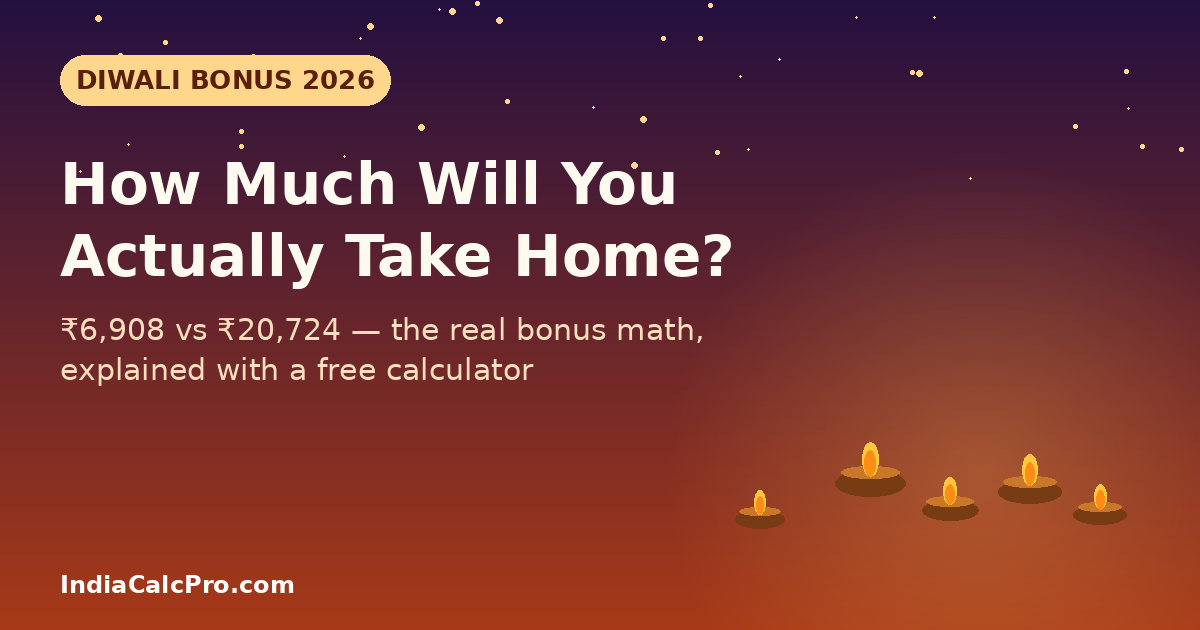
The ₹6,908 vs ₹20,724 story
For central government employees, the non-productivity-linked (ad-hoc) festival bonus isn't calculated on your actual salary — it's calculated on a fixed calculation ceiling of ₹7,000 a month, or your actual monthly basic pay, whichever is lower. Since almost every eligible employee earns more than ₹7,000, the ceiling decides the payout for nearly everyone.
The formula for a full 30-day bonus works out to:
₹7,000 ÷ 30.4 × 30 days = ₹6,908
On 27 August 2026, the National Council (Staff Side) of the JCM wrote to the Cabinet Secretary asking the government to raise that ceiling to ₹21,000 for this year's bonus. If accepted, the same 30-day bonus would jump to:
₹21,000 ÷ 30.4 × 30 days = ₹20,724
As of now, the ₹21,000 ceiling is a demand, not a confirmed change — the order is typically issued just before Dussehra, which falls on 20 October 2026 this year. Employees under a separate Productivity Linked Bonus (PLB) scheme, such as railway staff, are treated differently and can get significantly more — railway employees are eligible for up to 78 days of PLB, capped at ₹17,951.
Who is eligible for the ad-hoc bonus
- You must have been in service on 31 March 2026
- You need at least six months of continuous service in the financial year
- Six to eleven months of service gets a pro-rata (reduced) amount
What about private-sector and performance bonuses?
If you work in the private sector, your bonus usually falls into one of two buckets:
- Statutory bonus — for eligible employees under the Payment of Bonus Act, 1965, calculated as 8.33% of basic salary (or ₹100, whichever is higher), up to a prescribed maximum.
- Performance or discretionary bonus — a lump sum tied to appraisal ratings or company performance, entirely at the employer's discretion.
Is your Diwali bonus taxable?
Yes. A bonus — whichever kind — is treated as part of your salary income and is taxed at your applicable income tax slab rate, exactly like the rest of your pay. It isn't a separate, lighter tax category. Your employer typically factors the bonus into your projected annual income and adjusts TDS accordingly, which is why a bonus month's payslip sometimes shows a bigger-than-usual tax deduction — it isn't being taxed twice, it's just catching up on the year's total.
Two things worth checking before you spend it:
- Which regime you're filing under this year changes how much of that bonus you actually keep — compare both with the Income Tax Calculator.
- If a bonus pushes your income into a higher slab for the year, it's worth re-checking your total tax outgo rather than assuming last year's numbers still apply.
Work out your exact take-home
Rather than estimating, run your own numbers:
- Use the Bonus Calculator to work out your statutory, performance, or festival bonus amount and its tax impact.
- Check your full year's tax position with the Income Tax Calculator (old vs new regime, FY 2026-27).
- Planning to put the bonus toward a loan prepayment or a fresh EMI this festive season? Model it first with the EMI Calculator.
- If you're routing part of it into an SIP instead of spending it, the SIP Calculator shows what that lump sum could grow into.
The bottom line
Most people will see ₹6,908, not ₹20,724 — the higher number depends on a demand that hasn't been approved yet. Whatever the final order says, the way to know your real number is the same: check the applicable ceiling or percentage, run it through a calculator, and account for tax before you plan how to spend it.